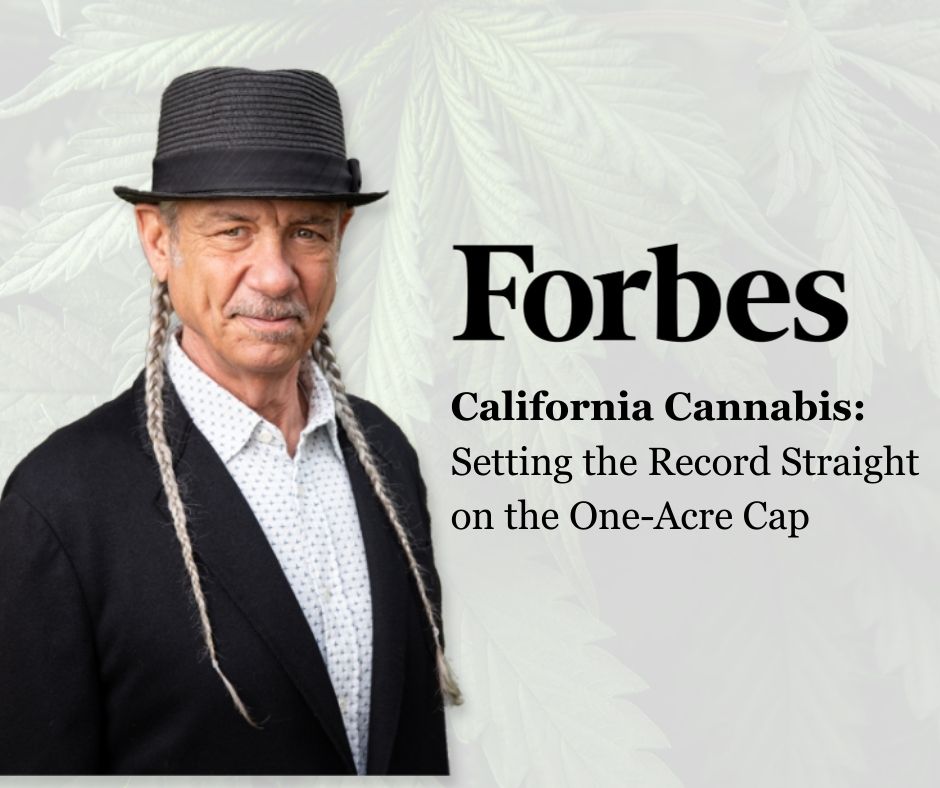
For years, a false rumor has circulated that I was responsible for removing a one-acre cap on cannabis cultivation in California. Until now, I have stayed mostly silent—not because the rumor was true, but because I didn’t want to give oxygen to a story that had no basis in fact. But over time, this false narrative has been repeated by advocates and journalists who didn’t bother to fact check the story, and now threatens to become a part of the historical record. My friend and leading cannabis attorney Bob Hoban recently addressed and debunked the rumor in a recent Forbes article.
Living with this false narrative has been by far the most painful experience of my activist career, but it hasn’t just affected me. Other activists, including some of the most effective advocates in the Emerald Triangle have been painted with the same brush– and as a result been ostracized and in some cases terrorized in the very communities they spent their lives defending.
By substituting scapegoating for honest analysis, the one-acre myth has fractured our community at the very moment we most need unity. Rather than confronting the true forces that shaped the California industry’s collapse, we’ve turned on each other. We’ve wasted precious time, energy, and trust telling stories about events that never happened, while the people and policies that actually caused the harm go unchallenged.
The spread of this rumor has damaged relationships among longtime allies—between growers and advocates, between those who grew plants in the hills and those who distributed that cannabis in the cities, between different parts of a community that had long been united by our shared love of the Plant. These alliances were never perfect, but they were forged in the fires of prohibition, and they carried us through the decades when nobody believed we could win.
We cannot afford to keep fighting ghosts. The truth matters—not just because it clears my name and other activists’ names– but because it gives us a common ground to stand on. If we want to change what happens next, we need to stop arguing about what never happened, and start working together to fix what really did happen.
Opinion | Setting the Record Straight on California’s One-Acre Cannabis Cap
By Bob Hoban
Steve DeAngelo is no small figure in the evolution of the commercial cannabis sector – many have called him the ”Father of the Legal Cannabis Industry.“ I have watched Steve from afar and have known him for many years. I have worked alongside him on various projects over the years from Mexico City, MX to Roanoke, VA, and many places in between. Recently, I sat down with him to talk about the state of the California cannabis industry. In doing so, one particular issue came up and really seemed to perturb Steve – the One-Acre Cannabis Cap. So I dove beneath the surface to explore this issue more deeply.
For years, a persistent myth has circulated in cannabis industry circles: that Steve DeAngelo—founder of Harborside and one of the most visible figures in cannabis reform—was responsible for license stacking and the elimination of California’s one-acre cultivation cap. This myth first emerged in the wake of a 2017 article that did not take the full legislative history of license stacking into account and was later repeated in other publications. A more fully informed understanding of the relevant law and regulations paints a very different picture.
The groundwork for license stacking in California began in October 2015, when lawmakers passed the Medical Marijuana Regulation and Safety Act (MMRSA). This framework allowed licensed dispensaries to cultivate up to four acres and permitted multiple licenses on a single property. It also gave local governments a deadline: establish your own cultivation rules or default to the state’s.
In the months that followed, Humboldt, Monterey, and several municipalities passed ordinances authorizing cultivation in excess of one acre. Humboldt allowed up to four acres per operator and up to twelve acres on some parcels (Humboldt County Code §314-55). Cities like Desert Hot Springs, Coalinga, and San Jose approved unlimited license stacking or large-scale operations. In one instance, Coalinga sold a former prison to a cannabis company for more than $4 million.
Then came Proposition 64 (2016), passed by voters, legalizing adult-use cannabis. State agencies then set about reconciling the preexisting medical cannabis regulations with the new adult-use law.
In April 2017, the California Department of Food and Agriculture (CDFA) issued draft regulations that stated: “The Department shall not restrict the total number of cultivation licenses a person is authorized to hold, provided the person’s total licensed canopy does not exceed four acres.” The term “person” included both individuals and businesses.
A key element in the one-acre myth was the idea that Steve supposedly influenced CDFA to remove the one-acre cap in November 2017, but by the time CDFA issued emergency regulations that month, the legal foundation for license stacking was well established. Industrial-scale operations were already underway. Jurisdictions had issued entitlements, and state agencies would have faced legal liability had they attempted to reverse course. Not long thereafter, Santa Barbara County unveiled a licensing program with a cap of 186 acres.
Steve DeAngelo never asked anyone to remove a one-acre cap. He never authorized a cultivation plan beyond Harborside’s four-acre entitlement. In fact, Harborside only began cultivation after the City of San Jose mandated full vertical integration for dispensaries back in 2014. Their farm was built not to dominate the market, but to comply with local law. In order to build out that farm, they brought in investors, and Harborside’s legal name was changed to FLRish.
Yes, FLRish lobbied in 2017—but not on canopy limits. Their efforts focused on keeping doors open for people with cannabis convictions, including DeAngelo himself, who had a prior felony from the pre-legalization era. They also opposed a regulatory scheme that would have forced all transactions through third-party distributors, hurting the small growers FLRish had supported for years.
Steve explained, “The new regulations posed two existential threats, two knives at our throats. One was the felony exclusion—it would have made it impossible to convert FLRish’s medical cannabis licenses into adult-use licenses. And the mandatory distribution scheme would have forced us to sever our relationships with the 500 small growers who supplied FLRish, and instead purchase all our cannabis from distributors who knew nothing about the plant.”
At CDFA, FLRish weighed in on real compliance issues: provisional licensing, CEQA timelines, canopy definitions, pesticide and testing standards, track-and-trace rollouts, labor safety, and environmental protocols. There was no ask to expand cultivation limits.
Now, with federal cannabis reform looming, it’s time to set the record straight. The future of this industry depends on fact-based policymaking and mutual respect—not finger-pointing rooted in old myths.
License stacking in California was the product of years of legislative development, local ordinances, and public regulatory processes—not the actions of one man. To suggest otherwise isn’t just incorrect—it does a disservice to the movement that made legalization possible.
KMUD Interview with Steve DeAngelo
No audience means more to me than the small growers that helped us build Harborside, so I was deeply grateful to be invited to The Cannabis Show on KMUD Community Radio, broadcasting in the heart of the Emerald Triangle. In the first half of the show, we deconstruct the one acre myth. In the second half, we take unscreened questions and comments from listeners.
 For years, a false rumor has circulated that I was responsible for removing a one-acre cap on cannabis cultivation in California. Until now, I have stayed mostly silent—not because the rumor was true, but because I didn’t want to give oxygen to a story that had no basis in fact. But over time, this false narrative has been repeated by advocates and journalists who didn’t bother to fact check the story, and now threatens to become a part of the historical record. My friend and leading cannabis attorney Bob Hoban recently addressed and debunked the rumor in a recent Forbes article.